








Mara Lee: Loving Others, Othering Love
€25
Keyword: lyric essay, feminism, gender, racism, postcolonialism, Swedish scholar
Subtitle: On a Few Tropes and Emotions that Shape the Image of the Stranger Size: 135 x 210 mm Pages:232 Format: hardcover Edition: 600 copies Language: English Translation: Sarah Clyne Sundberg, Jennifer Hayashida Book design: Sandra Praun & Oscar Guermouche Printing: Rotolito Publisher: Praun & Guermouche Pub Year: 2022 Weight: 560 gr ISBN 13: 9789198524499Description
Article no.: 9789198524499
Uncovering the racist duplicity of love
From the publisher:
“Loving Others, Othering Love” is a multi-modal lyric essay that investigates the interdependence of love and racism. It is a text that mines the multitude of ways that each requires the other in efforts to normalize or mask white privilege. Here, Lee marshals her analyses out of such material as Swedish newspaper reporting on racist hate crimes, Mary Shelley’s Frankenstein, Princess Bari, Ovid, and the manifesto of mass shooter Elliot Rodger. Startling in its elegant incisions into the literary, the popular, the public, and the mythological, Loving Others, Othering Love enacts a critical poetics of assemblage in order to reveal the racist duplicity of love.
Mara Lee is one of Sweden’s most prominent contemporary writers, as well as a translator and scholar. She is the author of several novels and volumes of poetry, including the internationally recognized Ladies from 2007 and award winning Love and Hate from 2018. Lee’s work mobilizes the paradoxes and confluences that emerge when the physical and linguistic realities of sexuality, gender, and race manifest themselves against the backdrop of Swedish welfare state whiteness, its quotidian power and purported racelessness. She is professor of art, art theory, and art history at Konstfack University of Arts, Crafts and Design, and guest professor at the Royal Institute of Art in Stockholm.
About the book design:
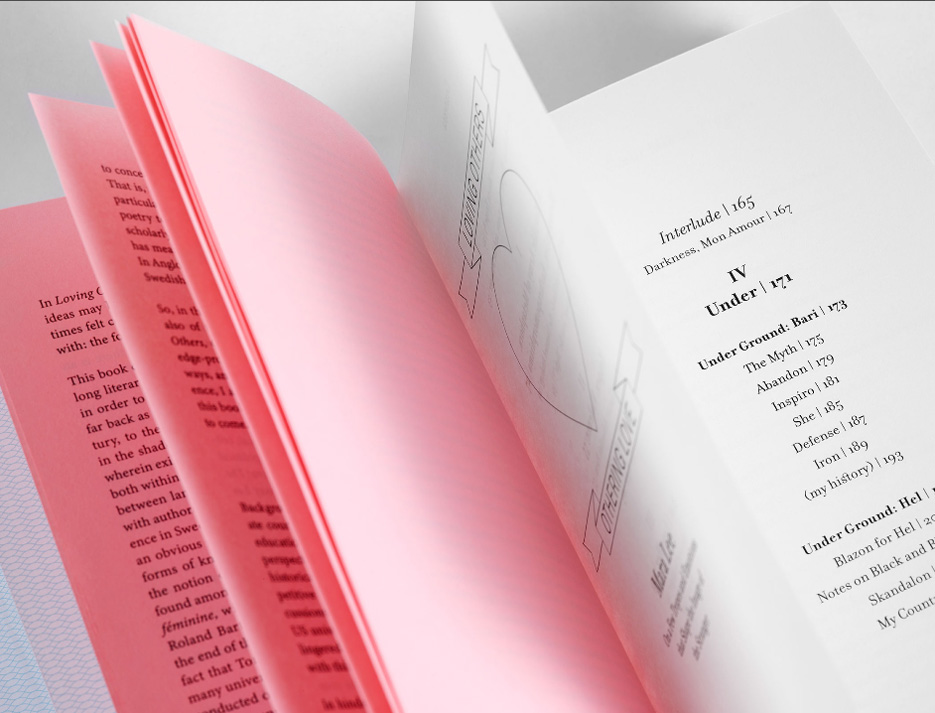
The cover with the debossed metallic emblem that dominates the front, together with the pattern of the endpapers, alludes to the passport.
The passport is the traveler’s document, the stranger’s. It marks nationality and citizenship, but not belonging, not where one actually comes from; belonging is in the body, in the blood, in the color of the skin. In turn, the debossed emblem, a heart with two banners, alludes to the tattoo – a mark on the skin, stigma, but also history, memory, dedication. The heart follows into the book and marks the translator’s comments in the footnotes. The preface is printed on pink pages. The symbol-laden color signals girlhood, the sweet, the virgin, while carrying a history of power and struggle and feminism.
The first page of the chapter “Beauty” is partly covered by a shimmering surface in mother-of-pearl; the phrase “and they wonder why I dance” in “Inspiro” is debossed, sort of stamped down into the page, which gives an echo on the other side; in “Monstrum” a punched line extends along an entire page, straight through the sentence “Because the monster is torn and tears apart, from longing.”
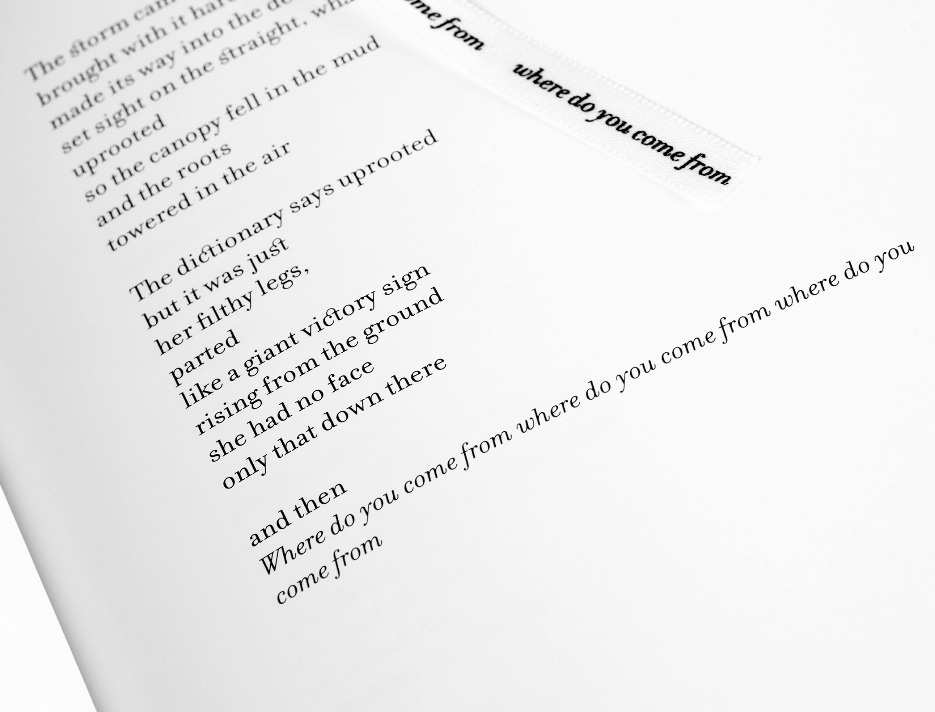
A repetition of a phrase in “Under Ground: Whole”: “where do you come from” runs on the ribbon bookmark.